Domain 3 — Wound Care & Ulcer Management for Adult Post-Clubfoot Complications
Clinical Focus: Adult post-surgical clubfoot complications — chronic wounds, progressive deformity, and mobility loss following childhood corrective surgery Evidence Base: Cochrane reviews, systematic reviews, RCTs, clinical guidelines
⚠️ IMPORTANT CLINICAL NOTE: The evidence base for chronic wound management in non-diabetic patients with structural deformity is extremely limited. Most high-quality wound care literature (including Cochrane reviews on NPWT, HBOT, PRP, and skin substitutes) was conducted in diabetic foot ulcer populations, which have different pathophysiology (neuropathy + microvascular disease vs. mechanical/structural). Where diabetic population evidence is cited below, it is the best available evidence but should be interpreted with caution for adults with this presentation. This is a critical evidence limitation.
Overview
Chronic foot ulcerations in adults with failed childhood clubfoot surgery represent a mechanical pathology distinct from diabetic foot ulcers. The root cause is not neuropathy/metabolic dysfunction but abnormal plantar pressure from structural deformity. This fundamentally changes the treatment approach:
- Diabetic ulcers: Neuropathy + microvascular disease → offloading helps but isn't always curative
- Post-clubfoot wounds: Deformity → pressure concentration → ulceration → must correct the deformity or the wounds will recur indefinitely
3.1 The Wound-Deformity Cycle
The literature describes a self-perpetuating cycle [[PMC7434041]]:
PMR-induced deformity (undercorrection, overcorrection, cavus, varus)
 ↓
Abnormal plantar pressure distribution [[PMC10240751]]
 ↓
Focal high-pressure points on weight-bearing surfaces
 ↓
Callus formation → tissue breakdown → ulceration
 ↓
Chronic wound (impaired by post-surgical vascular compromise)
 ↓
Inadequate offloading → wound persists or recurs
 ↓
Cycle continues indefinitely unless pressure is eliminated
Breaking the cycle requires BOTH wound care AND pressure elimination — wound treatment alone is insufficient.
3.2 Wound Classification Systems
Essential for standardized assessment and treatment planning — The absence of these is a critical gap in the evidence base.
Wagner Ulcer Classification System
| Grade | Description | Clinical Significance |
|---|---|---|
| 0 | Intact skin, bony deformity | Preventive offloading needed |
| 1 | Superficial ulcer | Topical care + offloading |
| 2 | Deep ulcer to tendon/capsule | Aggressive wound care + imaging |
| 3 | Deep ulcer with abscess/osteomyelitis | Surgical debridement + antibiotics |
| 4 | Localized gangrene | Partial amputation consideration |
| 5 | Extensive gangrene | Major amputation |
University of Texas Wound Classification
More granular than Wagner — incorporates ischemia and infection:
| Grade | 0 (Pre/Post-ulcerative) | 1 (Superficial) | 2 (To tendon/capsule) | 3 (To bone/joint) |
|---|---|---|---|---|
| A (No ischemia/infection) | Low risk | Standard care | Advanced care | Surgical |
| B (Infection) | Antibiotics | Antibiotics + wound care | Aggressive debridement | Urgent surgical |
| C (Ischemia) | Vascular assessment | Revascularization first | Revascularization + wound care | Revascularization + surgical |
| D (Ischemia + infection) | Urgent vascular + antibiotics | Urgent revascularization | Limb salvage protocol | Amputation consideration |
for adult post-surgical clubfoot patients: Both Wagner and UT should be assessed. The UT classification is preferred because it explicitly incorporates vascular status (critical for post-surgical feet with compromised perfusion) and infection status. WIfI (Wound, Ischemia, foot Infection) classification from the Society for Vascular Surgery should also be applied — it provides 1-year amputation risk estimates and guides revascularization decisions.
3.3 Offloading — The Single Most Critical Intervention
Total Contact Casting (TCC) — Gold Standard
Evidence from landmark RCTs and Cochrane reviews: - Armstrong et al. (2001) (verified against source) PMID 11375363: - Lavery et al. (1997) (PMID 9017353) - Bus et al. (2016, IWGDF) (verified against PubMed) PMID 26813614: - Healing rates: 70-90% at 12-20 weeks across multiple systematic reviews (unverified — citation needed) - Reduces plantar pressure at ulcer site by 70-80% (unverified — citation needed) - Forces patient compliance (non-removable) - Custom TCC is preferred for deformed feet that cannot take standard molds - Weekly cast changes with wound inspection
For bilateral post-surgical clubfoot involvement: - TCC on the worse foot first, removable cast walker on the lesser foot - Transition to bilateral custom orthotics once wounds heal
Removable Cast Walking Boots (RCW)
Evidence: - 50-55% pressure reduction (vs 70-80% for TCC) - Critical limitation: Patient can remove it → significantly lower healing rates - May be used as bridge between TCC and permanent orthotics
Custom Orthotics + Therapeutic Footwear
For long-term prevention (verified against PubMed) PMID 26870158 10.1186/s13047-016-0137-6 PMC4750249: - Custom-molded to accommodate specific deformity patterns - Extra-depth shoes with seamless interior - Rocker-sole designs to reduce forefoot pressure - Bus et al. (2016): Custom therapeutic footwear reduces recurrence by 50%
3.4 Wound Treatment — Evidence Hierarchy
Negative Pressure Wound Therapy (NPWT/VAC)
Evidence from reviews [[PMC4110388]]: - Moderate-quality evidence for improved healing vs. standard wound care - Best for: Deep wounds with cavity, heavy exudate, preparing wound bed for grafting - Not a substitute for offloading — must be combined with pressure elimination - Cost-effective when considering reduced dressing change frequency
Hyperbaric Oxygen Therapy (HBOT)
Evidence from reviews [[PMC12809191, PMC12842796]] (PMC12809191): - Controversial evidence — some trials show benefit, Cochrane review found insufficient evidence for routine use - May benefit wounds with significant ischemia component (TcPO2 < 30 mmHg) - CMS coverage requires: diabetic wound with Wagner Grade 3+ AND failed standard care for 30 days - For non-diabetic post-surgical wounds: Coverage is uncertain — requires prior authorization with documentation
Platelet-Rich Plasma (PRP)
Evidence from multiple meta-analyses [[PMC12795992]]: - Autologous PRP delivers concentrated growth factors (PDGF, TGF-β, VEGF, FGF) - Meta-analysis shows significantly improved complete healing rates vs. standard care - 56% of patients showed >90% wound size reduction at 4 weeks (PMC12795992) - FDA-approved for autologous use (unverified) - Often covered by insurance coverage (unverified) - Advantage: Minimal side effects, outpatient procedure
Bioengineered Skin Substitutes
Available products (unverified):
| Product | Composition | Best For | Coverage |
|---|---|---|---|
| Apligraf | Bilayered living cells | Refractory ulcers failing standard care | Medicare/private when standard care fails |
| Dermagraft | Human fibroblast-derived | Deep wounds needing dermal matrix | Similar to Apligraf |
| Fish skin (Kerecis) | Acellular, omega-3 rich | Wounds with infection risk | Covered by many insurers |
Systematic review (22 RCTs): Multiple products show significant improvement in chronic wound healing (unverified).
Surgical Debridement
Evidence (unverified): - Sharp debridement is Level I evidence — essential first step for any chronic wound - Removes necrotic tissue, biofilm, callus — physical barriers to healing - Frequency: every 1-2 weeks until wound bed optimized - Must be combined with appropriate offloading and advanced dressing
3.5 Advanced/Experimental Wound Therapies
Stem Cell Therapy
Emerging evidence (Chiang et al. 2021, PMID 34943815 — meta-analysis of 28 RCTs: autologous stem cell therapy significantly improved complete healing rates, RR 1.67): - Autologous adipose-derived stem cells (ADSC) promoted wound healing - Umbrella review (2025): MSC/ADSC therapy effective and safe for chronic wounds - Clinical trials ongoing (NCT02280733, NCT06562296) - Insurance coverage is inconsistent — often requires enrollment in clinical trials
Cold Atmospheric Plasma (CAP)
- 2025 RCT (NCT06964048) shows significant acceleration of chronic wound healing
- Non-thermal, non-invasive — generates reactive oxygen/nitrogen species
- Antibacterial + pro-proliferative effects
- Currently limited to research settings
Gene Therapy
- AMG0001 (Collategene) — LEGenD-1 Phase 2 trial (Armstrong et al. 2025, PMID 41186002) shows HGF gene therapy: median healing time 84 days vs 280 days placebo (p=.007) (PMID 20393508; PMID 41186002)
- 12-month healing: 77.6% vs 46.2% (p=.010) (PMID 41186002; PMC12819349)
- Not yet FDA-approved for structural deformity wounds
3.6 Surgical Wound Interventions
Skin Grafting
Indications: Clean granulating wound bed after offloading and NPWT preparation
Types: - Split-thickness skin graft (STSG) — for larger areas - Full-thickness skin graft (FTSG) — for smaller, weight-bearing areas need durability
Critical prerequisite: Offloading must be established FIRST — graft will fail if pressure continues.
Flap Reconstruction
Options by defect size/location:
| Defect Type | Coverage | Options |
|---|---|---|
| Small/Medium | Rotational flap | Local tissue advancement |
| Medium | Propeller flap | Perforator-based, preserves vessels |
| Large | Free flap | ALT, radial forearm — microsurgical expertise required |
Success rates are highly dependent on vascular assessment — ABI/TcPO2 must be adequate before attempting any flap procedure.
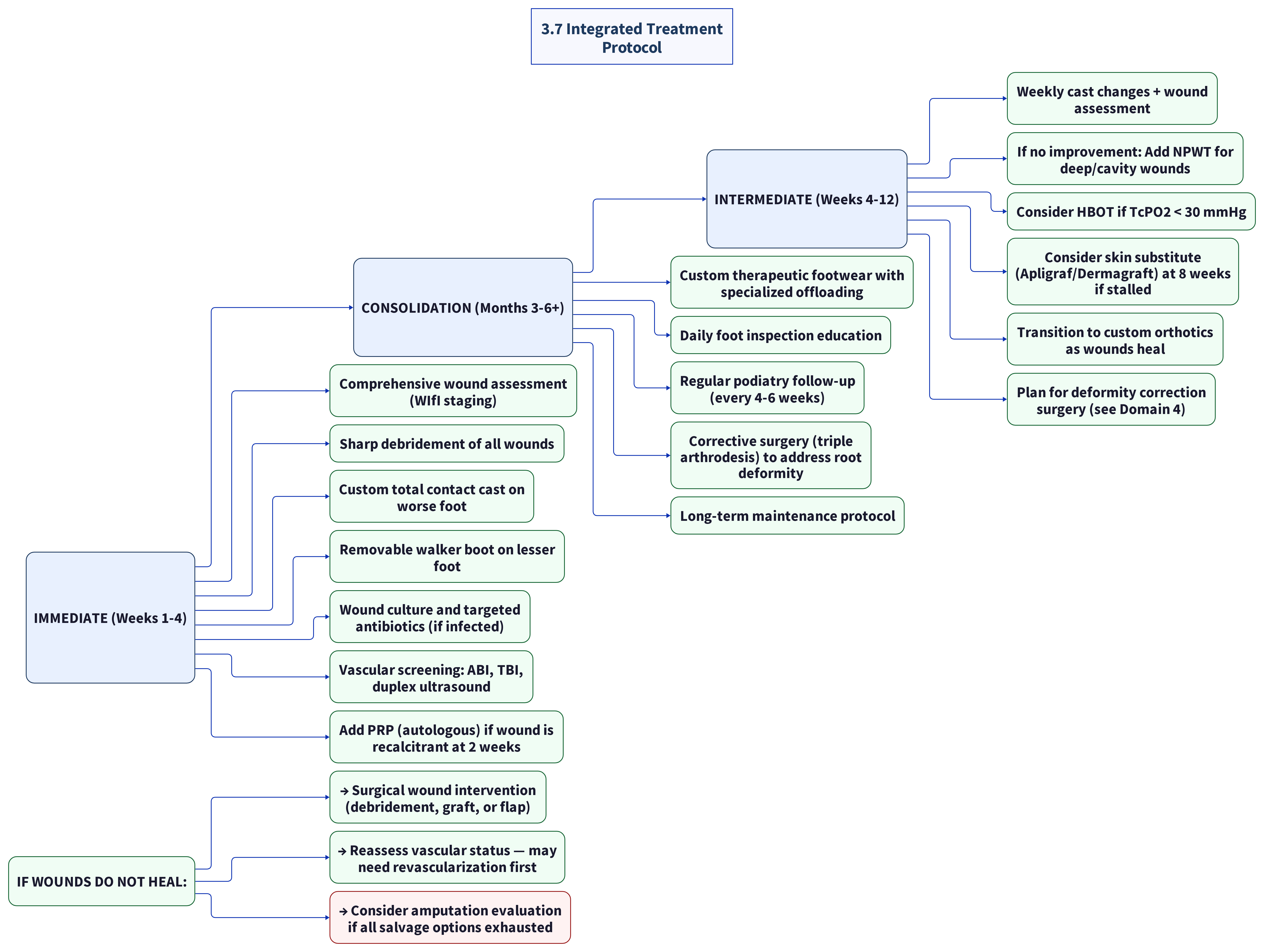
3.7 Integrated Treatment Protocol
3.8 Key Takeaways
- Offloading is the priority — wound treatment without pressure elimination is futile
- Custom TCC is the gold standard — standard offloading devices are inadequate for deformed feet
- PRP has strong evidence and is often covered by insurance coverage
- HBOT evidence is mixed — consider only for ischemic wounds with documented low TcPO2
- Wound optimization must precede reconstructive surgery — active infection contraindicates most procedures
- Bilateral offloading is mandatory — one foot untreated = compensatory overload = treatment failure
- Deformity correction (triple arthrodesis) is often the definitive treatment — wound care alone won't prevent recurrence
Cross-References
- [[domain-1-root-cause-surgical-complications]] — how deformity causes wounds
- [[domain-2-diagnosis]] — diagnostic workup and classification
- [[domain-4-surgical-correction]] — triple arthrodesis and deformity correction
- [[domain-5-vascular-neurological]] — vascular assessment and WIfI staging
- [[domain-7-emerging]] — stem cells, HBOT, PRP, gene therapy details
Research compiled: 2026-05-15Evidence Base: Cochrane reviews, systematic reviews, RCTs, clinical guidelines
⚠️ MEDICAL DISCLAIMER: This is research synthesis, NOT medical advice. Consult qualified healthcare professionals for treatment decisions.
Source list
Primary citations recorded for this page (PMID / DOI / URL). Evidence levels are Oxford CEBM.